
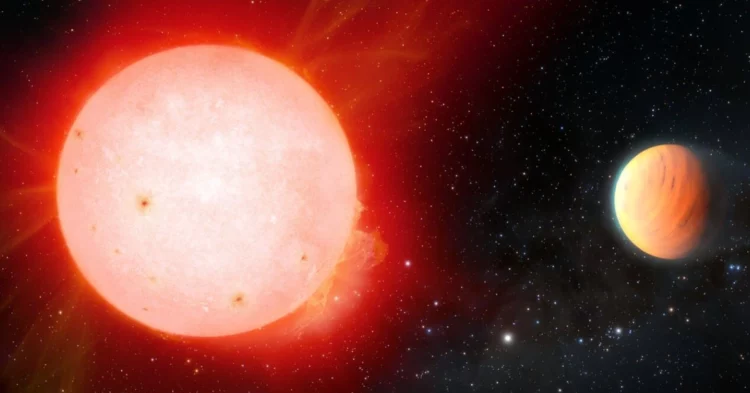
Astronomers have uncovered a planet that defies long-held beliefs about planetary formation. Dubbed TOI-6894b, this gas giant is larger than Saturn yet orbits a red dwarf star just one-fifth the mass of our Sun. The discovery, made using data from NASA’s Transiting Exoplanet Survey Satellite (TESS), challenges expectations about what types of stars can host massive planets—and how common these systems might be.
Table of Contents
TOI-6894: A Dim Star With an Oversized Planet
TOI-6894 is a low-mass, cool red dwarf, emitting only a small fraction of the Sun’s light. Despite its modest size, it plays host to TOI-6894b—a puffed-up gas giant whose radius exceeds that of Saturn, though its mass is only about half as much.
Lead researcher Edward Bryant, from University College London, described the discovery as both exciting and unexpected. “I originally searched through TESS observations of more than 91,000 low-mass red dwarf stars looking for giant planets,” he said. “What we found with TOI-6894b rewrites what we thought we knew about planetary formation around small stars.”
Bryant and his team confirmed the planet’s existence using high-resolution observations from the Very Large Telescope (VLT) in Chile.
Rethinking Planet Formation: Why TOI-6894b Is So Unusual
A Tiny Star With a Massive Companion
TOI-6894’s small size makes it the lowest-mass star ever found to host a transiting gas giant, making this pairing highly unusual. It’s 60% smaller than the next-smallest star known to harbor such a large planet. This fact alone forces astronomers to reassess the frequency and nature of gas giants in the galaxy.
“Most stars in the Milky Way are small red dwarfs like TOI-6894,” noted co-author Daniel Bayliss of the University of Warwick. “We didn’t think stars like this could host gas giants. But now, we’re reconsidering how many such planets might actually be out there.”
A Challenge to Standard Formation Theories
Traditionally, scientists believed that low-mass stars had thin protoplanetary disks—insufficient for forming large planetary cores before the gas dissipates. That’s why TOI-6894b poses a puzzle.
“It’s hard to explain how such a massive planet could have formed around such a small star,” said co-author Vincent Van Eylen of UCL. “This forces us to test and refine our models of planet formation.”
The team explored multiple formation theories. One possibility is that TOI-6894b formed through an intermediate core-accretion process, while another scenario involves gravitational instability—where parts of the disk collapse directly into a planet. However, current data doesn’t neatly support either path, leaving the planet’s origin unresolved.
A Cold, Puffy Giant With an Unusual Atmosphere
Chilly Temperatures and Rare Chemistry
Though large, TOI-6894b orbits far enough from its star that it remains relatively cool. Its equilibrium temperature is around 420 Kelvin (about 147°C or 297°F)—cold for a gas giant by exoplanet standards.
“This temperature range suggests a methane-rich atmosphere, which is very rare and scientifically valuable,” explained co-author Amaury Triaud from the University of Birmingham. “It could even contain detectable ammonia—something we’ve never seen in an exoplanet atmosphere.”
TOI-6894b is now a high-priority target for the James Webb Space Telescope (JWST), which could reveal its atmospheric composition in unprecedented detail. These observations could shed light on the balance of carbon, nitrogen, and oxygen in planets beyond our solar system.
Implications for the Galaxy: A New Era of Planetary Search
“This discovery reshapes the landscape of exoplanet exploration,” said co-author Andrés Jordán of the University Adolfo Ibáñez. “It challenges existing models and presents a valuable opportunity to study planet formation under extreme conditions.”
As astronomers continue searching TESS data and other surveys, TOI-6894b becomes a cornerstone example for how even the most modest stars might host surprisingly massive planets. If such systems prove common, our understanding of the Milky Way’s planetary population could shift dramatically.
A Bold Reminder: Planet Formation Still Holds Surprises
TOI-6894b stands as a striking reminder that planet formation is a flexible, and sometimes surprising, process. Its existence not only opens up new possibilities in the search for gas giants around small stars—it also emphasizes the importance of continuing to explore systems that defy our expectations.
This groundbreaking discovery was led by an international team from University College London, the University of Warwick, the University of Birmingham, and collaborating institutions around the globe.